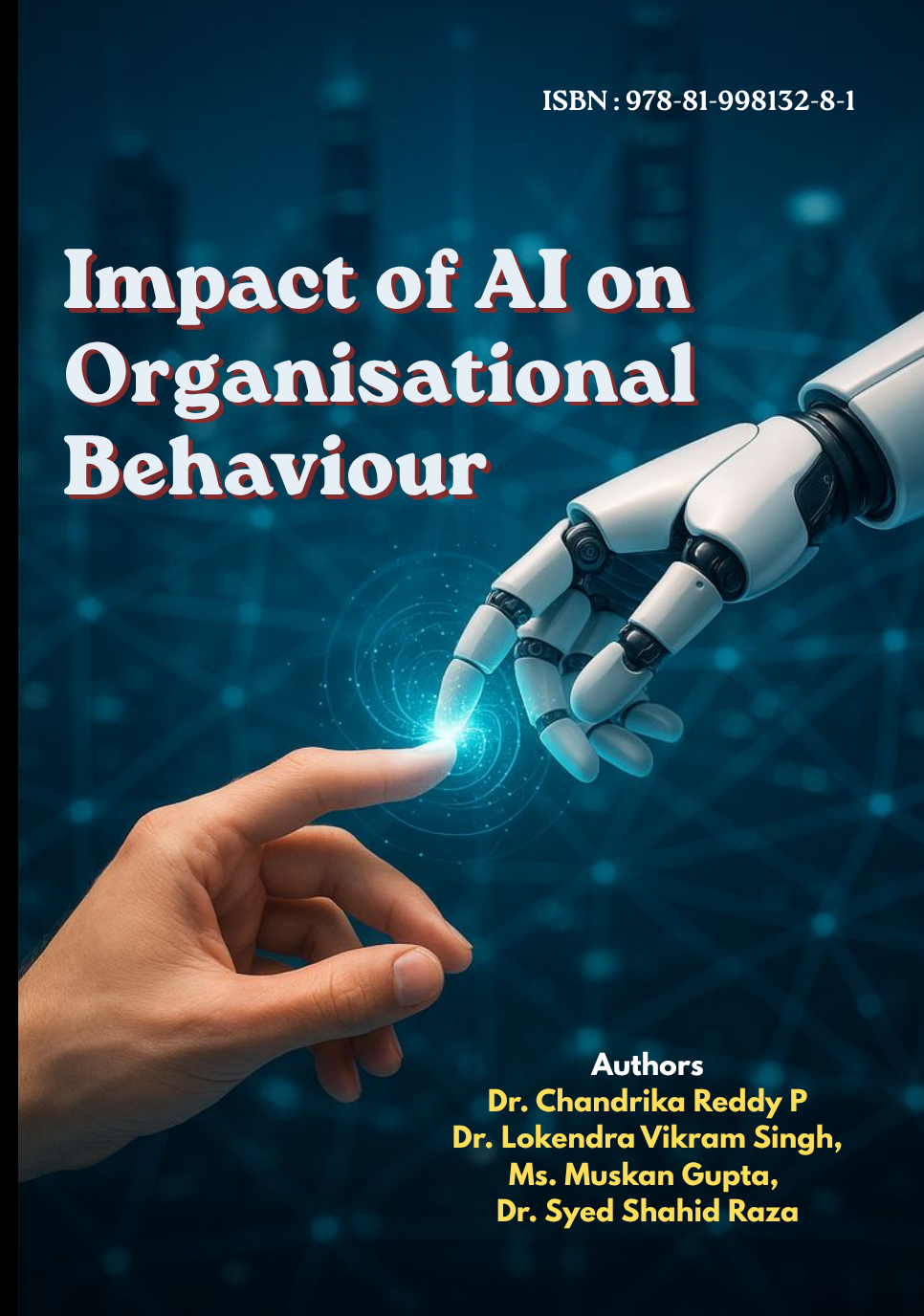
Impact of AI on Organisational Behaviour
ISBN:
978-81-998132-8-1Preface
The rapid advancement of Artificial Intelligence (AI) is fundamentally reshaping the way organizations function, compete, and evolve in the modern world. What was once considered a futuristic concept has now become an integral part of everyday business operations, influencing decision-making, communication, leadership, and workplace dynamics. As organizations increasingly adopt AI-driven technologies, there is a growing need to understand how these innovations affect not only productivity and efficiency but also human behaviour within the workplace. Organisational behaviour, traditionally centered on human interactions, motivation, leadership, and culture, is undergoing a significant transformation in the age of intelligent systems. AI is redefining roles and responsibilities, altering power structures, and reshaping the relationship between employees and technology. From automation of routine tasks to AI-assisted decision-making, employees are required to adapt to new ways of working, often leading to shifts in job satisfaction, engagement, and skill requirements. This work aims to explore the multifaceted impact of AI on organisational behaviour, examining both the opportunities and challenges it presents. On one hand, AI enhances efficiency, enables data-driven insights, and supports better decision-making. On the other hand, it raises concerns related to job displacement, ethical considerations, employee resistance, and the need for continuous learning and reskilling. Furthermore, the integration of AI into organisational settings calls for a re-examination of leadership styles and management practices. Leaders are now expected to balance technological advancement with human-centric approaches, fostering trust, transparency, and inclusivity in an increasingly digital workplace. Organisational culture, too, must evolve to embrace innovation while maintaining employee well-being and ethical standards. This preface sets the stage for a comprehensive discussion on how AI is influencing organisational behaviour across various dimensions. It is intended to provide readers with a foundational understanding of the topic while encouraging critical reflection on the future of work in an AI-driven world. The insights presented aim to benefit students, researchers, academicians, and professionals who seek to navigate and understand the complex interplay between artificial intelligence and human behaviour in organizations.
References
1. Brynjolfsson, E., Li, D., & Raymond, L. (2023). Generative AI at work: Evidence from organizational adoption. MIT Sloan Research Paper.
2. Davenport, T. H., & Ronanki, R. (2022). Artificial intelligence for the real world of work. Harvard Business Review, 100(5), 108–116.
3. Dwivedi, Y. K., et al. (2023). Artificial intelligence (AI): Multidisciplinary perspectives on emerging challenges. International Journal of Information Management, 69, 102553.
4. Gkorezis, P., & Bellou, V. (2022). AI adoption and employee behavior in organizations. Journal of Business Research, 145, 874–885.
5. Huang, M. H., & Rust, R. T. (2023). AI in service and organizational behavior transformation. Journal of Service Research, 26(2), 125–140.
6. Kaplan, A., & Haenlein, M. (2022). The challenges and opportunities of AI in organizations. Business Horizons, 65(3), 339–348.
7. Langer, M., König, C. J., & Busch, V. (2022). Changing leadership in AI-enabled organizations. Leadership Quarterly, 33(6), 101655.
8. Lee, J., & Shin, S. (2024). AI-driven decision-making and organizational structure changes. Decision Support Systems, 172, 113982.
9. Malik, A., Budhwar, P., & Srikanth, N. (2023). AI and the future of human resource management. Human Resource Management Review, 33(1), 100910.
10. Manyika, J., et al. (2023). The economic impact of generative AI on workplaces. McKinsey Global Institute Report.
11. Marler, J. H., & Boudreau, J. W. (2022). An evidence-based review of AI in HRM. Human Resource Management Review, 32(4), 100898.
12. Gajula, S. (2025). Architectural transformation of legacy financial systems: a framework for microservices, cloud, and API integration. Int. J. Inform. Technol. Manag. Inform. Syst, 16(2), 1201-1218.
13. Gajula, S. (2023). A Review of Anomaly Identification in Finance Frauds using Machine Learning System. International Journal of Current Engineering and Technology, 13(06).
14. Raisch, S., & Krakowski, S. (2022). Artificial intelligence and management: The automation–augmentation paradox. Academy of Management Review, 47(1), 192–210.
15. Russell, S. (2023). Human-compatible AI and organizational decision-making. AI Magazine, 44(2), 12–25.
16. Shrestha, Y. R., et al. (2023). AI-enabled organizational transformation: A review. Information Systems Frontiers, 25, 1–18.
17. Stahl, B. C. (2023). Ethical implications of AI in organizations. Journal of Business Ethics, 182(3), 721–735.
18. Tursunbayeva, A., et al. (2022). AI in human resource management: A systematic review. International Journal of Information Management, 65, 102518.
19. Verganti, R., Vendraminelli, L., & Iansiti, M. (2023). AI platforms and organizational redesign. Organization Science, 34(5), 1821–1840.
20. Wilson, H. J., & Daugherty, P. R. (2022). Collaborative intelligence: Humans and AI working together. Harvard Business Review, 100(4), 114–123.
21. Zhang, B., & Dafoe, A. (2024). Artificial intelligence governance and workplace transformation. AI & Society, 39(1), 45–62.