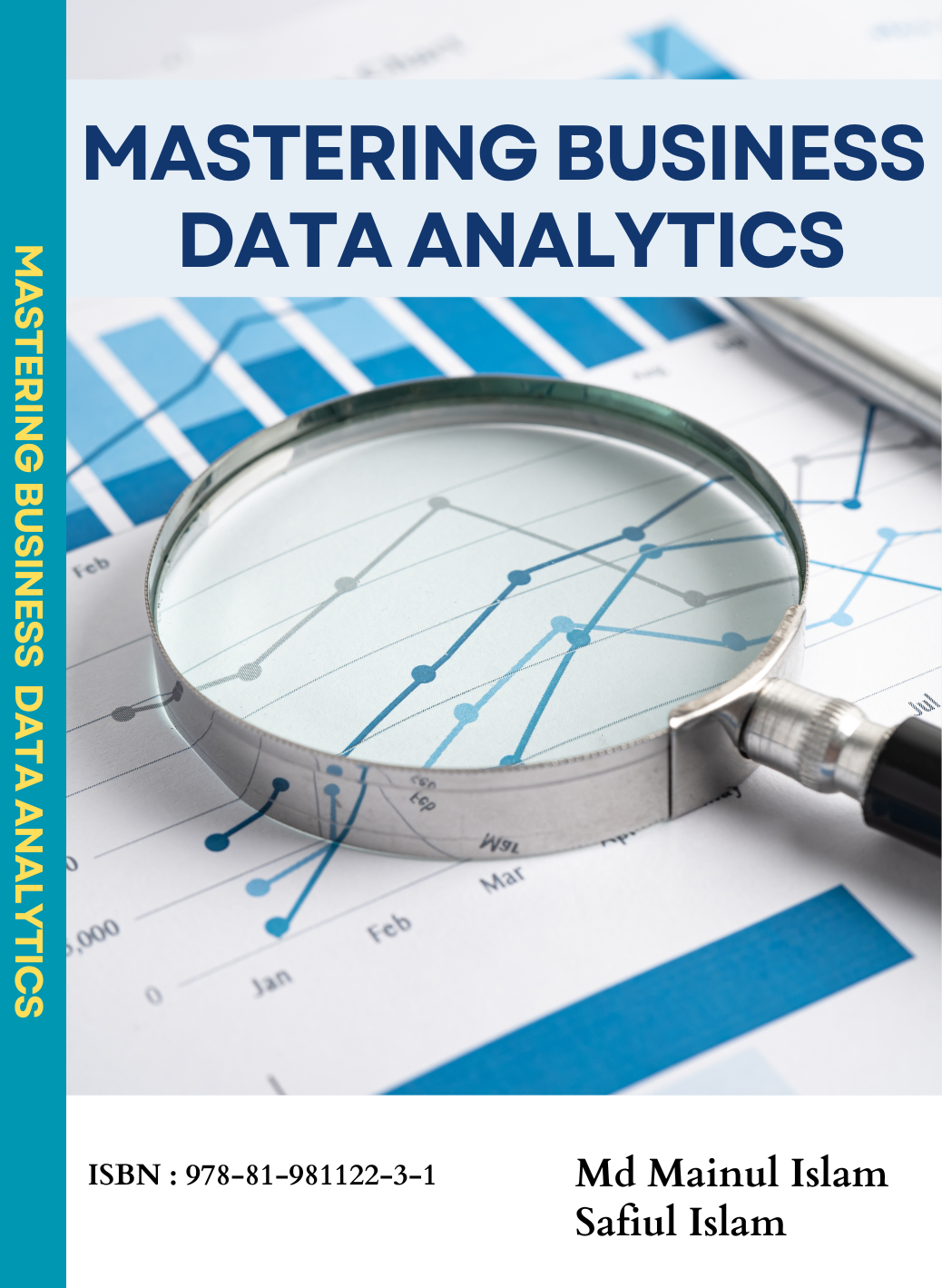
Mastering Business Data Analytics
Keywords:
978-81-981122-3-1Abstract
Mastering Business Data Analytics is written to help readers understand the growing importance of data analytics in today’s business world. In the digital age, organizations generate vast amounts of data every day, and the ability to analyze and use this information effectively has become essential for business success. This book aims to provide a clear and practical introduction to business data analytics and its applications across various industries.
The book covers important concepts such as data analysis, business intelligence, data visualization, predictive analytics, and decision-making techniques. It explains how organizations use analytical tools and technologies to improve performance, understand customer behavior, manage risks, and develop effective business strategies. Real-world examples and practical insights are included to make learning easier and more meaningful.
This book is designed for students, researchers, educators, business professionals, and entrepreneurs who wish to develop knowledge and skills in business analytics. The content is presented in a simple and structured manner so that readers from different academic backgrounds can easily understand the subject.
In addition to technical knowledge, the book also highlights the importance of ethical data usage, privacy, and responsible decision-making in modern organizations. Understanding these aspects is essential in today’s data-driven environment.
It is hoped that Mastering Business Data Analytics will serve as a valuable resource for readers seeking to understand and apply data analytics for academic, professional, and organizational growth.
References
1. Brynjolfsson, E., Li, D., & Raymond, L. (2023). Generative AI at work: Evidence from organizational adoption. MIT Sloan Research Paper.
2. Davenport, T. H., & Ronanki, R. (2022). Artificial intelligence for the real world of work. Harvard Business Review, 100(5), 108–116.
3. Dwivedi, Y. K., et al. (2023). Artificial intelligence (AI): Multidisciplinary perspectives on emerging challenges. International Journal of Information Management, 69, 102553.
4. Gkorezis, P., & Bellou, V. (2022). AI adoption and employee behavior in organizations. Journal of Business Research, 145, 874–885.
5. Huang, M. H., & Rust, R. T. (2023). AI in service and organizational behavior transformation. Journal of Service Research, 26(2), 125–140.
6. Kaplan, A., & Haenlein, M. (2022). The challenges and opportunities of AI in organizations. Business Horizons, 65(3), 339–348.
7. Langer, M., König, C. J., & Busch, V. (2022). Changing leadership in AI-enabled organizations. Leadership Quarterly, 33(6), 101655.
8. Lee, J., & Shin, S. (2024). AI-driven decision-making and organizational structure changes. Decision Support Systems, 172, 113982.
9. Malik, A., Budhwar, P., & Srikanth, N. (2023). AI and the future of human resource management. Human Resource Management Review, 33(1), 100910.
10. Manyika, J., et al. (2023). The economic impact of generative AI on workplaces. McKinsey Global Institute Report.
11. Marler, J. H., & Boudreau, J. W. (2022). An evidence-based review of AI in HRM. Human Resource Management Review, 32(4), 100898.
12. Gajula, S. (2025). Cybersecurity Risk Prediction Using Graph Neural Networks. Authorea Preprints.