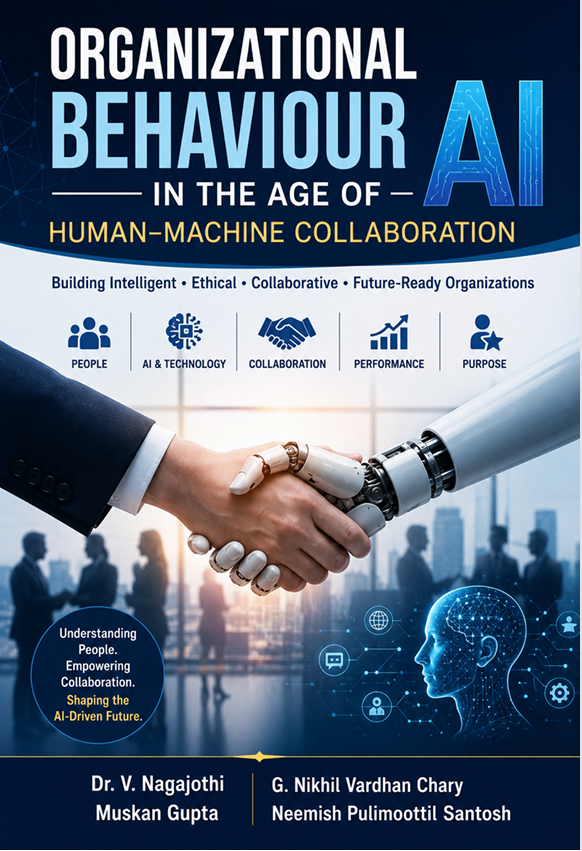
Organizational Behaviour in the Age of AI Human–Machine Collaboration
Keywords:
978-81-686168-2-0Abstract
The rapid advancement of Artificial Intelligence (AI) is transforming the way organizations operate, communicate, and make decisions. From automated workflows and intelligent analytics to collaborative robots and AI-powered assistants, technology is reshaping the modern workplace at an unprecedented pace. As organizations increasingly adopt AI-driven solutions, the relationship between humans and machines has become a critical area of study within Organizational Behaviour.
This book, Organizational Behaviour in the Age of AI: Human–Machine Collaboration, explores how AI is influencing individual behavior, team dynamics, leadership practices, organizational culture, communication, decision-making, and employee well-being. While technology offers significant opportunities for innovation, productivity, and efficiency, it also presents challenges related to trust, ethics, job redesign, workforce adaptation, and human-centered management.
The objective of this book is to provide students, researchers, educators, managers, and industry professionals with a comprehensive understanding of organizational behaviour in the digital era. By integrating traditional organizational behaviour concepts with contemporary AI applications, the book highlights how human capabilities and intelligent technologies can work together to create sustainable and effective workplaces.
Throughout the chapters, readers will discover theoretical foundations, practical examples, emerging trends, and real-world applications that demonstrate the evolving nature of work. Special attention is given to the importance of maintaining human values, emotional intelligence, creativity, and ethical responsibility in an increasingly automated environment.
As we move toward a future where human–machine collaboration becomes the norm rather than the exception, understanding the behavioral implications of AI is essential for organizational success. It is our hope that this book serves as a valuable resource for navigating the opportunities and challenges of the AI-powered workplace.
We extend our sincere gratitude to our academic colleagues, students, researchers, and professionals whose insights and experiences have contributed to the development of this work. We also thank our readers for their interest and commitment to understanding the future of organizational behaviour in an age of technological transformation.
References
1. Ameen, N., Pagani, M., Pantano, E., Cheah, J.-H., Tarba, S., & Xia, S. (2024). The rise of human–machine collaboration: Managers’ perceptions of leveraging artificial intelligence for enhanced B2B service recovery. British Journal of Management, 36(1), 91–109. https://doi.org/10.1111/1467-8551.12829
2. Bankins, S., Ocampo, A. C., Marrone, M., Restubog, S., & Woo, S. E. (2024). A multilevel review of artificial intelligence in organizations: Implications for organizational behavior research and practice. Journal of Organizational Behavior. https://doi.org/10.1002/job.2735
3. Hillebrand, L., Raisch, S., & Schad, J. (2025). Managing with artificial intelligence: An integrative framework. Academy of Management Annals. https://doi.org/10.5465/annals.2022.0072
4. Gajula, S., & Kandula, S. T. R. (2025, August). Securing Financial Data in Multi-Tenant Clouds Through AI, Blockchain, and Attribute-Based Encryption. In International Conference on Computing and Communication Networks (pp. 397-419). Cham: Springer Nature Switzerland.
5. Haesevoets, T., De Cremer, D., Dierckx, K., & Van Hiel, A. (2021). Human–machine collaboration in managerial decision making. Computers in Human Behavior, 119, 106730. https://doi.org/10.1016/j.chb.2021.106730
6. Glikson, E., & Woolley, A. W. (2020). Human trust in artificial intelligence: Review of empirical research. Academy of Management Annals, 14(2), 627–660. https://doi.org/10.5465/annals.2018.0057
7. Gillath, O., Ai, T., Branicky, M. S., Keshmiri, S., Davison, R. B., & Spaulding, R. (2021). Attachment and trust in artificial intelligence. Computers in Human Behavior, 115, 106607. https://doi.org/10.1016/j.chb.2020.106607
8. Makarius, E. E., Mukherjee, D., Fox, J. D., & Fox, A. K. (2020). Rising with the machines: A sociotechnical framework for bringing artificial intelligence into the organization. Journal of Business Research, 120, 262–273.
9. Jarrahi, M. H. (2018). Artificial intelligence and the future of work: Human–AI symbiosis in organizational decision making. Business Horizons, 61(4), 577–586.
10. Marikyan, D., Papagiannidis, S., & Rana, O. (2022). Artificial intelligence in the workplace: Implications for job design and employee experience. Information Systems Frontiers.
11. Meijer, A., Bolivar, M., & Wessel, R. (2021). Algorithmic management and public organizations: Human–AI interaction in decision systems. Government Information Quarterly.
12. Tong, S., Jia, N., Luo, X., & Fang, Z. (2021). The Janus face of artificial intelligence feedback: Deployment of AI in performance management. Journal of Marketing.
13. Nguyen, T., & Malik, A. (2022). Task–technology fit in AI-enabled workplaces: Effects on employee performance. Information & Management.
14. Sowa, M., Przegalinska, A., & Ciechanowski, L. (2021). AI assistants in organizational work: Adoption and human collaboration effects. Technological Forecasting and Social Change.
15. Verma, S., & Singh, S. (2022). Organizational culture and employee adaptation to AI-driven workplaces. Technological Forecasting and Social Change.
16. Kim, J., Park, Y., & Choi, H. (2022). AI-enabled customer service systems and employee collaboration. Journal of Service Research.
17. Meijer, A., & Bolívar, M. P. R. (2021). Governing the smart city: Human–AI collaboration in public administration. Public Administration Review.
18. Brynjolfsson, E., Li, D., & Raymond, L. (2023). Generative AI and the future of work: Productivity and augmentation effects. NBER Working Paper Series.
19. Makarius, E. E., et al. (2020). Algorithmic management in organizations: Implications for employee autonomy and control. Journal of Business Research.
20. Gajula, S. (2025, December). AI-Powered Forecasting Models, Optimizing Working Capital, Supply Chain Financing. In 2025 IEEE 1st International Conference on Recent Trends in Computing and Smart Mobility (RCSM) (pp. 1-6). IEEE.
21. Raisch, S., & Krakowski, S. (2021). Artificial intelligence and management: The automation–augmentation paradox. Academy of Management Review.
22. Faraj, S., Pachidi, S., & Sayegh, K. (2018). Working and organizing in the age of the learning algorithm. Information and Organization, 28(1), 62–70*.
23. Bhagwat, V. B. (2025). Simplifying Payroll Balance Conversions in Payroll Systems Implementation through the Use of Generative AI.
24. Bhagwat, V. B. (2023). Optimizing Payroll to General Ledger Reconciliation: Identifying Discrepancies and Enhancing Financial Accuracy. JOURNAL OF ADVANCE AND FUTURE RESEARCH, 1(4).