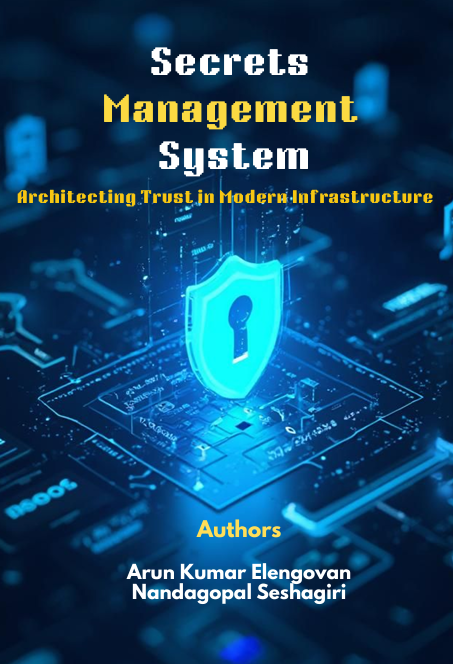
Secrets Management System: Architecting Trust in Modern Infrastructure
Abstract
This book began with a question that kept coming up in our work: What does it really mean
to protect a secret in a world where everything is connected and every action leaves a trace?
As we spent more time with modern systems and the people who run them, it became clear
that secrets are not just technical artifacts. They are the threads that bind digital systems
together. They shape identity, govern access, and define the boundaries of trust.
Across our years working with engineers, architects, and security teams, we both saw the
same patterns. Secrets buried in repositories. Credentials woven into pipelines. Keys that
lived far longer than anyone remembered. We also saw the determination of teams who
wanted to do better—who believed that security should come from good design, not good
fortune.
Those experiences pushed us to bring this book to life. Our goal is to combine the philosophy
behind trust with the practical discipline of secrets management. This book is for anyone
who builds, secures, or operates digital systems and understands that trust isn’t something
systems inherit. It’s something we design, evaluate, and continually renew.
We hope these chapters give you a clear view of how secrets shape systems, how they
influence the flow of power, and how thoughtful engineering can make trust more reliable.
More than anything, we hope this book helps you build systems with stronger integrity—
and encourages you to think differently about trust in the digital world.
References
1. Dalal, R. S., Howard, D. J., Bennett, R. J., Posey, C., Zaccaro, S. J., & Brummel, B. J. (2022). Organizational science and cybersecurity: Abundant opportunities for research at the interface. Journal of Business Psychology, 37(1), 1–29. https://doi.org/10.1007/s10869-021-09732-9
2. Ifinedo, P. (2022). Effects of security knowledge, self-control, and countermeasures on cybersecurity behaviors. Journal of Computer Information Systems, 63(2), 380–396. https://doi.org/10.1080/08874417.2022.2065553
3. Tursunbayeva, A., et al. (2022). AI in human resource management and cybersecurity implications. International Journal of Information Management, 65, 102518.
4. Gkorezis, P., & Bellou, V. (2022). AI adoption and employee cybersecurity behavior. Journal of Business Research, 145, 874–885.
5. Marler, J. H., & Boudreau, J. W. (2022). An evidence-based review of AI and HRM security risks. Human Resource Management Review, 32(4), 100898.
6. Huang, M. H., & Rust, R. T. (2023). AI transformation of service work and employee behavior. Journal of Service Research, 26(2), 125–140.
7. Gajula, S. (2025). Cybersecurity Risk Prediction Using Graph Neural Networks. Authorea Preprints.
8. Malik, A., Budhwar, P., & Srikanth, N. (2023). Artificial intelligence and cybersecurity in human resource management. Human Resource Management Review, 33(1), 100910.
9. Dwivedi, Y. K., et al. (2023). Artificial intelligence: Multidisciplinary perspectives on cybersecurity and organizational impacts. International Journal of Information Management, 69, 102553.
10. Stahl, B. C. (2023). Ethical implications of AI-driven cybersecurity in organizations. Journal of Business Ethics, 182(3), 721–735.
11. Lee, J., & Shin, S. (2024). AI-driven decision-making and organizational structure in cybersecurity. Decision Support Systems, 172, 113982.
12. Verganti, R., Vendraminelli, L., & Iansiti, M. (2023). AI platforms and organizational redesign in security systems. Organization Science, 34(5), 1821–1840.